

The Access Collector
One of nine personas from the India Luxury Traveller Benchmark 2026
A Luxury Tribe / ILLUME report
There is a kind of affluent Indian traveller for whom money has stopped being interesting. They can buy the suite, the table, the experience, and precisely because they can, none of it confers any distinction. What they want instead is the thing money alone cannot secure: the door that does not open for everyone, the room that cannot be booked, the moment that exists only for those who are known. For this traveller, the entire definition of luxury has shifted from purchase to proximity.
This is a meaningful signal about where Indian luxury is heading. As the country’s luxury goods market crosses ten billion dollars and the objects of wealth become available to an ever-widening affluent base, the line between rich and influential increasingly runs through access rather than acquisition. The India Luxury Traveller Benchmark 2026, published by Luxury Tribe, identifies the traveller who lives on the far side of that line as one of its four specialist personas, and as one of the clearest indicators of how status itself is being redefined among India’s elite.
The Access Collector.
Who they are
The Access Collector is animated by a single governing principle, which the Benchmark renders in their own register: if anyone can book it, it is not interesting. Their luxury is not comfort, not spectacle, not recovery, not even discernment. It is access, proximity to power, to culture, to the genuinely exclusive. The closed-hours museum. The backstage of the fashion show. The tasting that is not listed. The kitchen that does not open to outsiders. The invitation that cannot be bought.
Their signature orientation is the pursuit of doors that do not open for others. Where the Taste Investor wants depth and the Sovereignty Seeker wants invisibility, the Access Collector wants the rare privilege of being let in, and the value of any experience is, for them, inversely proportional to how many other people could have had it. Exclusivity is not a feature of the experience. It is the experience.
What distinguishes them from the eight personas around them is what they are actually collecting. The Wild-Luxe Connoisseur collects encounters with the wild; the Milestone Producer collects memories; the Taste Investor collects understanding. The Access Collector collects access itself, and, beneath it, the relationships and the standing that access represents. Each opened door is not only a moment but a node in a growing network, a proof of belonging among those who are known. Their emotional aftertaste is the feeling of being rare, not in what they have seen, but in who they are recognised to be.
View this post on Instagram
Why they exist
The Access Collector is the product of a status economy that India built domestically and is now exporting to the world.
The cultural force is the most distinctive, and it begins at home. India developed, over the last two decades, a rich domestic ecosystem of access-based status, the gallery openings, the literary festivals, the private chef dinners, the trunk shows, the invitation-only cultural moments where social weight is conferred not by what you paid but by whether you were asked. Getting invited to the right Mumbai gallery opening or the right Jaipur Literature Festival dinner carries a significance no purchase can replicate. This created a domestic status grammar built around access, and the Access Collector is the traveller who now carries that grammar outbound, arriving at international cultural moments expecting the same insider proximity they command at home. Their expectation of access is culturally trained, not merely aspirational.
The economic force underwrites the shift. As product luxury saturates and the objects of wealth become commonplace among India’s expanding affluent class, access becomes the new currency of differentiation. When everyone can buy the bag, the distinction migrates to the experience that cannot be bought, and access is the purest form of that distinction. The Benchmark, drawing on Luxury Tribe’s survey of 700 affluent Indian travellers and the proprietary ecosystem data of World Travel Magazine, locates this persona across a wide wealth band, from the upper-affluent to the ultra-high-net-worth, united not by spend level but by the conviction that the unbuyable is the only thing worth having.
There is a generational and global-positioning force layered on top. India’s younger affluent class, founders, creative entrepreneurs, globally networked professionals, treats luxury as a network-building exercise, where every access moment is an investment in a relationship infrastructure that compounds over time. And there is the particular posture of a country that is the world’s newest major luxury source market: the Access Collector’s hunger for insider moments is partly a response to being new on the global stage, proving belonging not through spending, which anyone can do, but through access, which requires being known. They are building, deliberately and internationally, the network that confirms they belong.
The Access Collector
How they travel
The Access Collector’s status style runs entirely through proximity. The signal is the room they were let into, the moment they were part of, the door that opened for them and not for others. It is a status legible only to those who understand what was required to be there, which is precisely the audience the Access Collector is addressing.
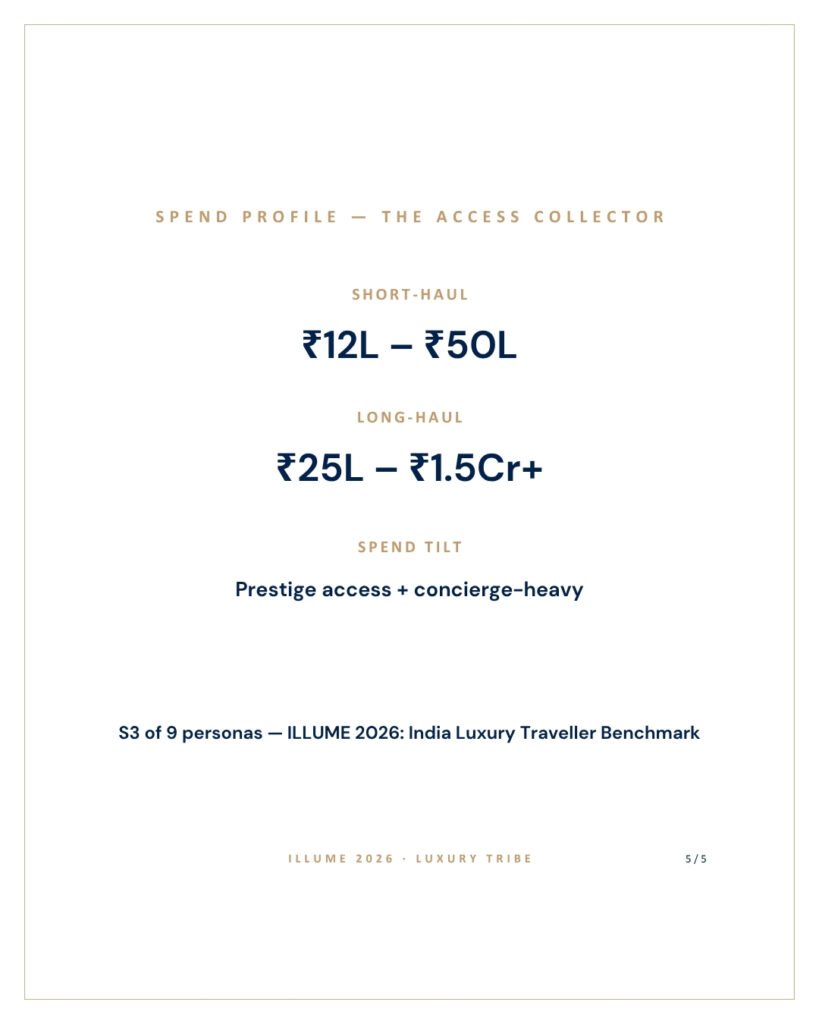
Their spend architecture concentrates on prestige access and the concierge infrastructure that delivers it. Concerts, fashion, cultural events, invitation-only experiences, these are where the budget flows, and the network that can secure them becomes the product the Access Collector is actually buying. For a short-haul trip the booking party might spend between ₹12 and ₹50 lakh; for a long-haul trip, between ₹25 lakh and a crore and a half and beyond. Events access is a meaningful and growing component of their demand. They are concierge-heavy and high-touch, because the value they seek can only be delivered through relationships, not transactions.
What loses them is the ordinary. Anything available to everyone, anything that can simply be booked, anything that signals the experience was packaged rather than opened. The moment an Access Collector senses that what they have been offered is generally available, its value collapses entirely. They are not difficult to please in the conventional sense; they are simply impossible to satisfy with anything that is not, in some genuine way, exclusive to them.
When the trip delivers, the aftertaste is the feeling of rarity and recognition, of having been let in, of belonging among those who are known, of having added another node to a network that confirms their standing. That is the Access Collector’s true reward, and it is why the property or advisor whose network becomes indispensable to them earns a loyalty that is very hard to displace.
The Access Collector
Where they sit in the nine
The Access Collector is one of nine personas, and their overlaps reveal the texture of the persona. They pair with the Taste Investor in the traveller who wants both depth and scarcity, the experience that is intellectually rewarding and genuinely exclusive at once, the biennale preview followed by the private atelier visit followed by the closed-hours museum walk. They pair with the Wild-Luxe Connoisseur in the traveller who wants not only the wildlife but the access behind it, the scientist’s briefing, the research station closed to tourists. These overlaps are mapped across the full report, along with the migration pathway in which the Access Collector emerges: from taste, to access, to the eventual sovereignty of the traveller who, having built the network, now protects it and attends only by invitation.
The trajectory points somewhere significant. By 2028, the Access Collector is moving from buying doors to building institutions, from collecting access toward creating it, from being invited toward becoming the person who invites, sitting on the boards, funding the fairs, shaping the cultural moments that others now seek entry to. It is the consumption-to-contribution arc of the India Luxury Traveller Benchmark 2026 in perhaps its most complete form: the traveller who stops consuming exclusivity and starts producing it.
That is the larger argument, and the reason a forum like ILLUME exists to make it: the Indian luxury traveller is not one profile, and the most telling of them may be the one who has moved past money entirely. The Access Collector is the persona that shows the industry where status is going, away from what can be purchased, toward what must be earned, opened, and known.
The India Luxury Traveller Benchmark 2026 profiles all nine personas across thirteen behavioural dimensions, with origin stories, real-world signal cards, overlap and migration maps, global benchmarking, and 2026–2028 trend trajectories. A Luxury Tribe / ILLUME report.