

The Wild-Luxe Connoisseur
One of nine personas from the India Luxury Traveller Benchmark 2026
A Luxury Tribe / ILLUME report
When a global safari operator or a remote luxury lodge thinks about the Indian market, the instinct is to file it under adventure, to assume that the affluent Indian who books a Kenyan conservancy or an Antarctic expedition is a thrill-seeker, a tourist collecting a bucket-list stamp. It is a costly misreading. The traveller who books these trips is frequently the most sophisticated luxury client in the entire Indian market, and treating their journey as an adventure rather than an achievement is exactly how a property loses them.
India’s affluent travelling class is now large enough, and varied enough, that such misreadings have real consequences. With 378,810 millionaires, an ultra-high-net-worth population growing fifty percent faster than the global average, and a luxury travel market worth USD 72.9 billion, the cost of engaging this market through a single flattened profile compounds quickly. The India Luxury Traveller Benchmark 2026 was built to replace that flattened profile with nine distinct personas, and this one, the fourth of the five core personas, is the persona that global wilderness and expedition brands most need to understand correctly.
The Wild-Luxe Connoisseur.
Who they are
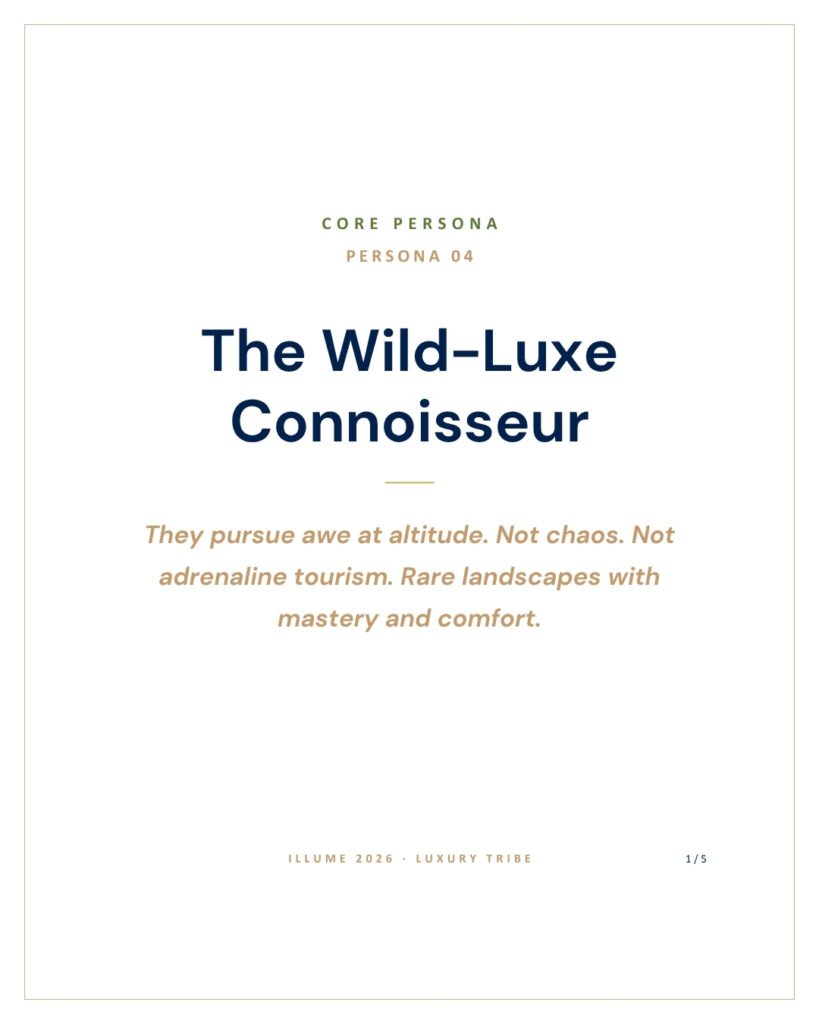
The Wild-Luxe Connoisseur is an awe-chaser who pursues status through rarity and demands comfort even in the most remote places on earth. They travel to encounter the wild, the great migration, the polar ice, the tiger at dawn, the gorilla in the forest, and they want that encounter delivered without surrendering the standard of luxury they live by everywhere else.
Their signature tension is precisely this: the desire for genuine remoteness held together with the refusal to be uncomfortable. They want the place that almost no one reaches, and they want it with the bed, the service, the food, and the discretion they would expect from a city palace. The remoteness is the point; the comfort is non-negotiable. The persona lives in the resolution of those two demands.
What distinguishes them from the eight personas around them is that the Wild-Luxe Connoisseur is, almost always, a late-stage luxury traveller. They have done the European city circuits. They have stayed in the famous hotels and eaten in the famous restaurants. They have graduated from destination-collecting to experience-deepening, and the wild is where that graduation leads, to encounters that cannot be reduced to a checklist, that cannot be bought casually, and that confer a rarer kind of status than any address. The emotional aftertaste they are paying for is the feeling of being rare.
View this post on Instagram
Why they exist
The Wild-Luxe Connoisseur is the product of maturity, both the maturity of the Indian luxury traveller and the maturity of India’s own wilderness industry.
Begin with the traveller. India’s globally exposed high-net-worth class, the entrepreneurs, promoters, and professionals who have already completed the obvious itineraries, reaches a point where the conventional markers of luxury travel no longer signify anything. Everyone in their circle has stayed in the same suites and photographed the same landmarks. What remains scarce is the experience that requires more than money: the encounter with something genuinely wild, genuinely remote, genuinely rare. This is the generational force the Benchmark identifies, the late-stage traveller seeking depth where breadth has been exhausted.
There is a cultural dimension that is specific to India and frequently missed. For the Indian traveller, the encounter with the wild is not entertainment. It carries an older resonance, the wild as something closer to sacred than to recreational. This elevates both the expectation and the emotional investment the traveller brings to the experience. The Wild-Luxe Connoisseur is not ticking off animals. They are seeking an encounter that means something, and that meaning is culturally rooted in a way that changes how the experience must be designed and delivered.
But the most underappreciated force is infrastructural, and it originates inside India. Over the last two decades India built its own luxury wilderness sector, Sujan in Rajasthan, Evolve Back in Karnataka, JAWAI and the new generation of properties that proved wild luxury could meet the highest international standard on Indian soil. This sector trained a domestic palate. The affluent Indian who learned what wild luxury could be at a Ranthambore or a Kabini now carries that expectation outbound, to Africa and the poles and beyond. The Benchmark, drawing on Luxury Tribe’s survey of 700 affluent Indian travellers and the proprietary ecosystem data of World Travel Magazine, documents this clearly: the domestic wilderness industry created the outbound Wild-Luxe Connoisseur. And the timing aligned with a supply-side pull, as Chinese outbound demand softened after 2020, African and polar operators began actively courting Indian high-net-worth travellers, opening doors that accelerated the persona’s growth.
The Wild-Luxe Connoisseur
How they travel
The Wild-Luxe Connoisseur signals status through the rarity of where they have been rather than the visibility of what they spent. The flex is the conservancy that takes only a handful of guests, the expedition that cannot be booked on any platform, the encounter that most people will only ever see on a screen. It is status through access to the rare, a quieter and more exclusive signal than spectacle.
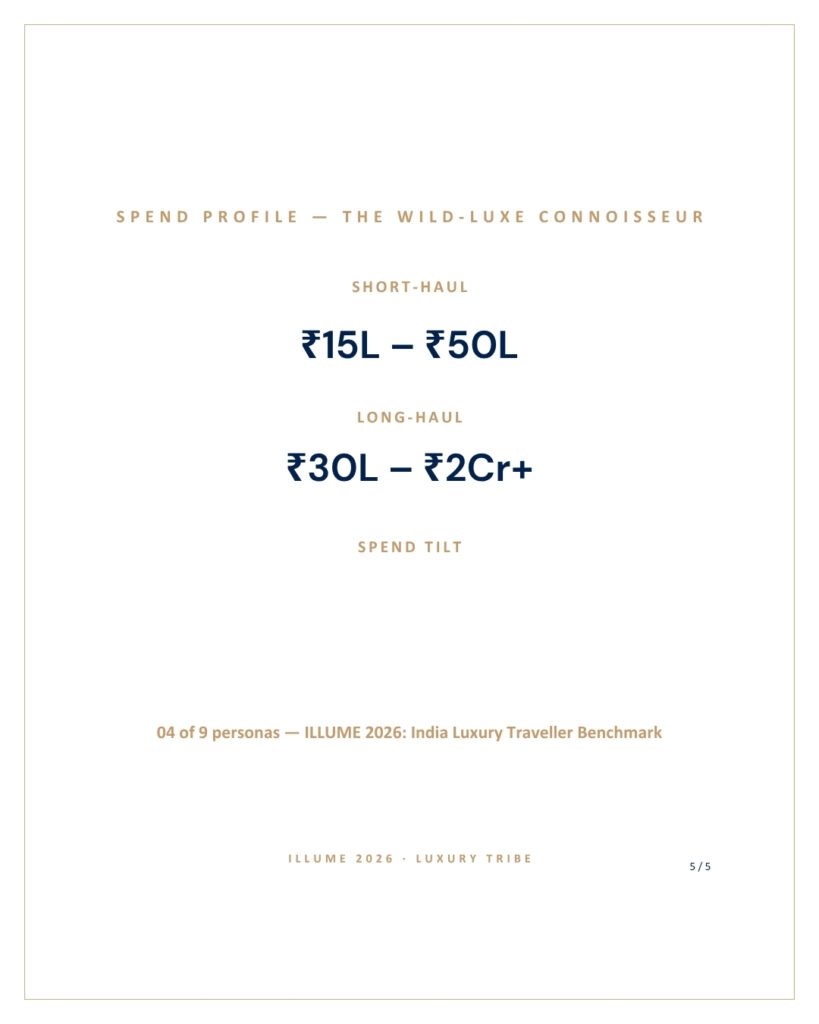
Their spend architecture concentrates on what makes the remote both reachable and comfortable. Private guides are essential, the guide, not the lodge, is frequently the difference between an ordinary sighting and an extraordinary one, and the Wild-Luxe Connoisseur knows it. Remote lodges, private access, and adventure excursions are the second most demanded upgrade in their entire spend pattern. For a short-haul wilderness trip the booking party might spend between ₹18 and ₹55 lakh; for a long-haul expedition, between ₹35 lakh and a crore and a half and beyond. The money flows toward expertise, access, and the infrastructure that makes remoteness liveable.
What loses them is the compromise that betrays either half of the tension, remoteness without comfort, or comfort that has sanded away the genuine wildness they came for. A lodge that is luxurious but tame disappoints them as much as an expedition that is wild but rough. They are paying for both at once, and both must be real.
When the trip delivers, the aftertaste is the feeling of rarity, of having reached something few others will, and having done so without surrendering the standard they live by. That feeling is the persona’s true product.
The Wild-Luxe Connoisseur
Where they sit in the nine
The Wild-Luxe Connoisseur is one of nine personas, and their connections are revealing. They overlap with the Access Collector in the traveller who wants not only the wildlife but the conservation scientist’s private briefing, the research station closed to tourists, the tagging programme no ordinary guest joins, where rarity of encounter and rarity of access converge. They overlap with the Restoration Seeker in the traveller who finds recovery in landscape rather than in a treatment room, for whom a Himalayan retreat or an African conservancy repairs the nervous system better than any spa. And they are frequently the next destination of the recovered Restoration Seeker, whose returning energy expresses itself as a hunger for the world’s wild places. These overlaps and migration pathways are mapped across the full report.
The trajectory points somewhere significant. By 2028, the Wild-Luxe Connoisseur is moving from witnessing wildlife to funding its preservation, from guest to patron, from observer to contributor to the conservation of the very places they travel to see. It is the clearest possible expression of the arc the India Luxury Traveller Benchmark 2026 traces across all nine personas: the migration from consumption to contribution, from receiving the experience to actively shaping and sustaining it.
That is the larger argument, and the reason a forum like ILLUME exists to make it: the Indian luxury traveller is not a single market, and certainly not a single adventure-seeking type. They are nine distinct stories, and the Wild-Luxe Connoisseur is the one who proves that the most sophisticated Indian luxury travellers have stopped collecting the world and started wanting to belong to its rarest parts.
The India Luxury Traveller Benchmark 2026 profiles all nine personas across thirteen behavioural dimensions, with origin stories, real-world signal cards, overlap and migration maps, global benchmarking, and 2026–2028 trend trajectories. A Luxury Tribe / ILLUME report.