

The Sovereignty Seeker
One of nine personas from the India Luxury Traveller Benchmark 2026
A Luxury Tribe / ILLUME report
There is a category of Indian luxury traveller the industry almost never sees clearly, for the simple reason that being seen is the one thing they will not tolerate. They do not appear in marketing databases. They do not leave reviews. They do not fill out preference forms or respond to campaigns or post about where they have been. They are among the wealthiest travellers India produces, and they have organised their entire travelling life around the principle of invisibility.
This is a problem for an industry built on visibility, on recognition, on loyalty programmes, on the celebration of the guest. India’s ultra-high-net-worth population is the fastest-growing in Asia, and a meaningful share of it travels this way: discreetly, privately, through intermediaries, leaving as little trace as possible. The India Luxury Traveller Benchmark 2026 identifies this traveller as one of the four specialist personas, infrequent in appearance but extraordinary in value, and impossible to win with any of the tools the industry usually reaches for.
The Sovereignty Seeker.
Who they are
The Sovereignty Seeker travels for discreet power and minimal exposure. Their luxury is control and anonymity, the ability to move through the world’s finest places without being noticed, recognised, or recorded. Where other personas signal their wealth in various registers, the Sovereignty Seeker signals nothing at all, deliberately, because their status is already established and their priority is to keep it shielded.
Their defining requirement is privacy, and it is not a preference but an operating standard. The Benchmark captures their language precisely: quiet, low visibility, separate, handled, no exposure. These are the words that recur in their requests, and they describe a complete philosophy of travel. The private entrance, not the grand lobby. The suite no one knows exists, not the celebrated one. The arrangement that has been handled, not the one that requires their visible participation. Private aviation is not an upgrade for this persona; it is the baseline from which everything else proceeds.
What distinguishes them from the eight personas around them is the inversion of the entire luxury logic. The Milestone Producer wants to be admired; the Access Collector wants to be known in the right rooms; the City-Plus Escapist wants a trip worth retelling. The Sovereignty Seeker wants none of it. They want to disappear into the highest quality available and emerge untouched, unphotographed, and unbothered. Their luxury is the absence of exposure.
View this post on Instagram
Why they exist
The Sovereignty Seeker is the product of what happens at the very top of a rapidly forming wealth structure, where visibility becomes a liability rather than an asset.
The economic force is the concentration of ultra-high-net-worth at the apex of India’s affluent class, the industrialists, the promoters of major enterprises, the politically prominent, the public figures whose names and faces carry weight and consequence. For this cohort, recognition is not a pleasure. It is a risk to be managed. The more established and visible the wealth, the greater the need to travel in a way that does not advertise it, and the Sovereignty Seeker emerges at the point where exposure stops being flattering and starts being dangerous.
There is a structural force in how this wealth operates. At this level, the principal rarely arranges anything themselves. The family office, the personal assistant, the trusted intermediary becomes the invisible decision-maker, and the Sovereignty Seeker’s bookings frequently arrive through these channels rather than from the traveller directly. The Benchmark documents this as a distinct feature of the Indian UHNI booking: the principal may never speak to the property at all, the entire transaction mediated through staff briefed to protect their discretion. This is not aloofness. It is infrastructure designed to maintain a perimeter.
And there is a cultural dimension specific to India. In a society where the trip performs in family and social networks, where visibility is so often the point, the Sovereignty Seeker represents the deliberate refusal of that performance, a refusal available only to those secure enough at the top that they no longer need to prove anything to anyone. Their privacy is itself a form of status, the ultimate one: the freedom to opt out of the visibility that everyone below them is still competing for. The Benchmark’s research, drawing on Luxury Tribe’s survey of 700 affluent Indian travellers and the proprietary ecosystem data of World Travel Magazine, identifies this persona at the UHNI-and-above tier, where the architecture of privacy becomes the architecture of the entire trip.
The Sovereignty Seeker
How they travel
The Sovereignty Seeker’s status style is, paradoxically, the deliberate absence of one. They do not signal. The signal is that there is no signal, the quiet arrival, the unmarked movement, the complete control over who knows they are there. Among people who understand the codes, this invisibility reads as the highest possible status, but it is not performed for an audience. It is maintained for its own sake.
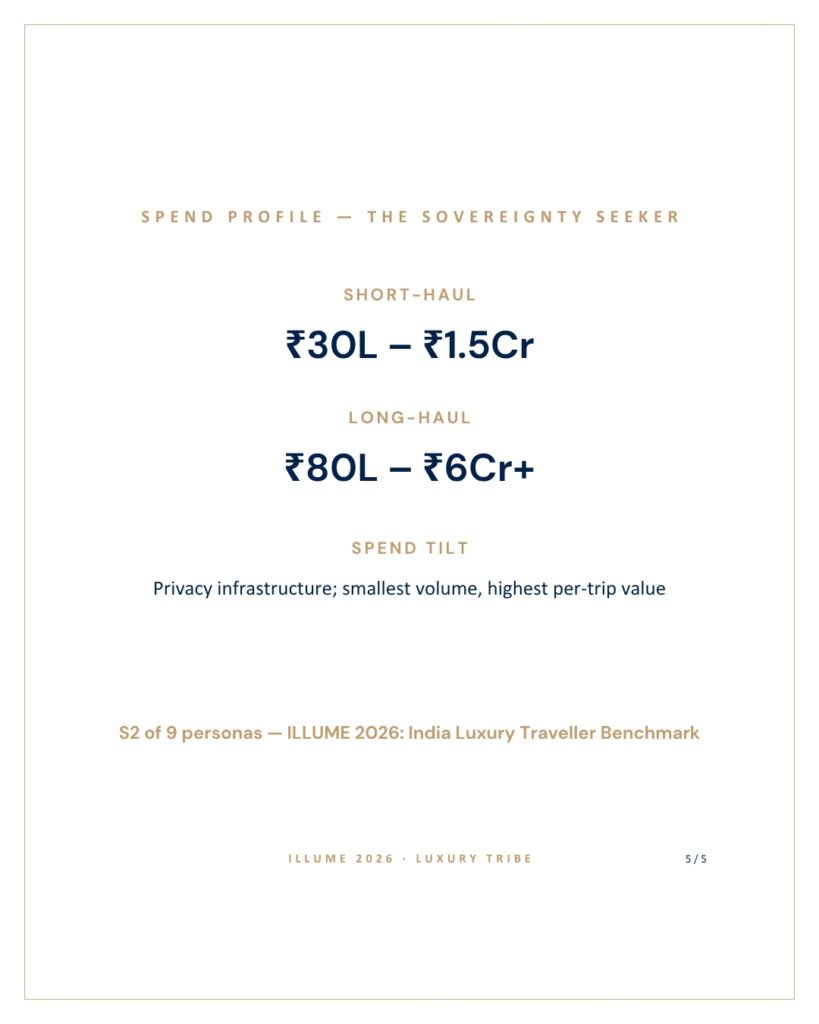
Their spend architecture treats privacy as the defining line item. The budget concentrates on whatever secures control and anonymity, the private entrance, the secluded property, the dedicated and discreet staff, the best-in-class amenities delivered without exposure, the private aviation that is simply assumed. For a short-haul trip the booking party might spend between ₹30 lakh and a crore and a half; for a long-haul journey, between ₹80 lakh and six crore and beyond. These are among the highest figures in the framework, and they buy not spectacle but seclusion.
What loses them is any breach of the perimeter. A staff member who fails to understand the discretion required. A property that posts about their stay. A logistical arrangement that forces them into public view. Any exposure, however minor, is not a service flaw to be apologised for, it is a fundamental violation of the contract, and it ends the relationship without appeal. The Sovereignty Seeker pays precisely to eliminate this risk, and a property that introduces it has failed at the one thing that mattered.
When the trip is executed correctly, the aftertaste is the deep satisfaction of having moved through the world untouched, control maintained, anonymity preserved, the perimeter intact from arrival to departure. That feeling produces extraordinary loyalty, because the properties capable of delivering it are vanishingly few.
The Sovereignty Seeker
Where they sit in the nine
The Sovereignty Seeker is one of nine personas, and the source of the single highest-value overlap in the entire framework. Paired with the Restoration Seeker, they become the ultra-high-net-worth traveller who is both publicly visible and privately depleted, needing invisibility and repair simultaneously, booking the private villa with the attached wellness programme where no one knows they are and the body is systematically restored. The Benchmark notes this overlap can exceed a crore for a ten-night stay and repeat annually if executed flawlessly. The Sovereignty Seeker also layers into the Multi-Gen Principal’s trip when the family patriarch is a public figure, imposing UHNI privacy requirements on the entire family assembly. These overlaps are mapped across the full report.
The trajectory is telling. By 2028, the Sovereignty Seeker is moving from purchasing privacy to owning the infrastructure of it, from booking discretion toward controlling the assets that guarantee it, the private residences, the owned vehicles, the proprietary arrangements that remove even the need to trust an outside party. It is the consumption-to-contribution arc of the India Luxury Traveller Benchmark 2026 in its most self-sufficient form: the traveller who stops buying the experience and starts owning the means of it.
That is the larger argument, and the reason ILLUME exists as a forum to make it: the Indian luxury traveller is not one profile, and some of the most valuable of them are defined precisely by their refusal to be seen. The Sovereignty Seeker is the persona that inverts every assumption the industry holds about how luxury announces itself, and rewards, richly and repeatedly, the rare properties that understand that the highest service is sometimes to behave as though the guest was never there at all.
The India Luxury Traveller Benchmark 2026 profiles all nine personas across thirteen behavioural dimensions, with origin stories, real-world signal cards, overlap and migration maps, global benchmarking, and 2026–2028 trend trajectories. A Luxury Tribe / ILLUME report.