

The Diaspora Bridge Traveller
One of nine personas from the India Luxury Traveller Benchmark 2026
A Luxury Tribe / ILLUME report
India’s diaspora is the largest in the world, 35.4 million people, spread across every major economy on earth, sending home a record 135 billion dollars in remittances in a single year. The macroeconomic story is well told. The travel story buried inside it is not. Because behind those numbers is a particular kind of affluent traveller, living a life divided across two or three countries, whose journeys follow a logic that neither the Indian travel industry nor the global one has correctly read.
This is a costly oversight. The diaspora is disproportionately affluent, Indian Americans are the highest-income group in the United States, British Indians earn the highest average wages of any ethnic group in the United Kingdom, and they travel constantly, at high value, in patterns that look nothing like conventional leisure. The India Luxury Traveller Benchmark 2026, published by Luxury Tribe, identifies this traveller as the last of its four specialist personas, and as one of the most misunderstood travellers in the entire framework, precisely because both sides of the industry project the wrong assumptions onto them.
The Diaspora Bridge Traveller.
Who they are
The Diaspora Bridge Traveller travels to stay connected across worlds. For them, home is not a single place but a plurality, India and another country, tradition and cosmopolitanism, the family network and the chosen life abroad. Their travel is not escape and not, in the ordinary sense, leisure. It is stitching: the continual work of holding together a life that is lived in more than one country at once.
Their signature tension is captured in a single line the Benchmark gives them: I belong everywhere, and nowhere fully. They move with genuine fluency between a five-star hotel in Paris, the family home in Mumbai, a cultural festival abroad, a temple visit at home, and that effortless cultural switching is itself their defining capability. But the fluency carries a cost. The belonging is layered, partial, never quite complete in any one place, and the travel is the means by which they keep all of it intact.
What distinguishes them from the eight personas around them is that their trips are rarely about a single purpose, and rarely fully their own to design. The Diaspora Bridge Traveller’s journeys are structured by obligation as much as desire, by the family wedding, the ageing parents, the festival season, the school holidays that must align across geographies. Their status style is not flamboyant but fluent: the signal is not what they spend but the ease with which they navigate multiple worlds. They are the persona for whom travel is infrastructure for a divided life.
View this post on Instagram
Why they exist
The Diaspora Bridge Traveller is the product of the structural globalisation of the Indian family, and the specific emotional cost of belonging to more than one country at a time.
The economic force is the affluence of the diaspora itself. Indians abroad are, in many of their host countries, among the most prosperous communities, which means the obligatory visit to India is increasingly accompanied by a substantial leisure dimension, and the capacity to travel well is rarely the constraint. As the diaspora ages into its peak family-travel years, the volume and value of this travel grows. The Benchmark, drawing on Luxury Tribe’s survey of 700 affluent Indian travellers and the proprietary ecosystem data of World Travel Magazine, situates this persona as a Global Indian traveller whose spending capacity is real and whose travel frequency is high.
The cultural force is the most powerful, and it is distinctly Indian. In Indian culture, physical presence is the primary currency of family loyalty. A video call cannot replace being at the festival, holding the grandchild, attending the pooja. This expectation creates a non-negotiable travel baseline that, as the Benchmark notes, no other diaspora community matches in intensity or frequency. The Diaspora Bridge Traveller does not choose whether to make the journey home. The journey is an obligation woven into the structure of the family itself, and it recurs, year after year, around the calendar of festivals, weddings, and the slow needs of ageing parents.
There is a structural force complicating all of it. Tightening immigration regimes across the United States, the United Kingdom, and Canada, combined with the complex visa routing required for multi-generational families holding mixed citizenships, are making the Diaspora Bridge Traveller’s journeys increasingly intricate. The family that spans three countries and several passport types needs its travel stitched together with real expertise, the multi-country routing, the visa compliance, the calendar alignment across school systems and work obligations and festival dates. This complexity is itself part of what defines the persona’s travel and shapes who can serve them well.
The Diaspora Bridge
How they travel
The Diaspora Bridge Traveller’s trips are typically multi-purpose and multi-stop, and they unfold in two distinct phases that the Benchmark draws out clearly. There is the obligation leg, the family duty in India, the wedding, the festival, the parents’ health appointments, the social rounds, which is emotionally weighty and culturally non-negotiable. And there is the reward leg, the leisure extension that follows, which almost always takes the form of another persona entirely: the City-Plus Escapist. After two weeks of family obligation, the Diaspora Bridge Traveller wants a short, high-energy break, Dubai, Singapore, Bangkok, followed by a resort reset. Easy, stimulating, high-reward-per-day. They are emotionally spent from the obligation leg, and the reward leg must not ask anything more of them.
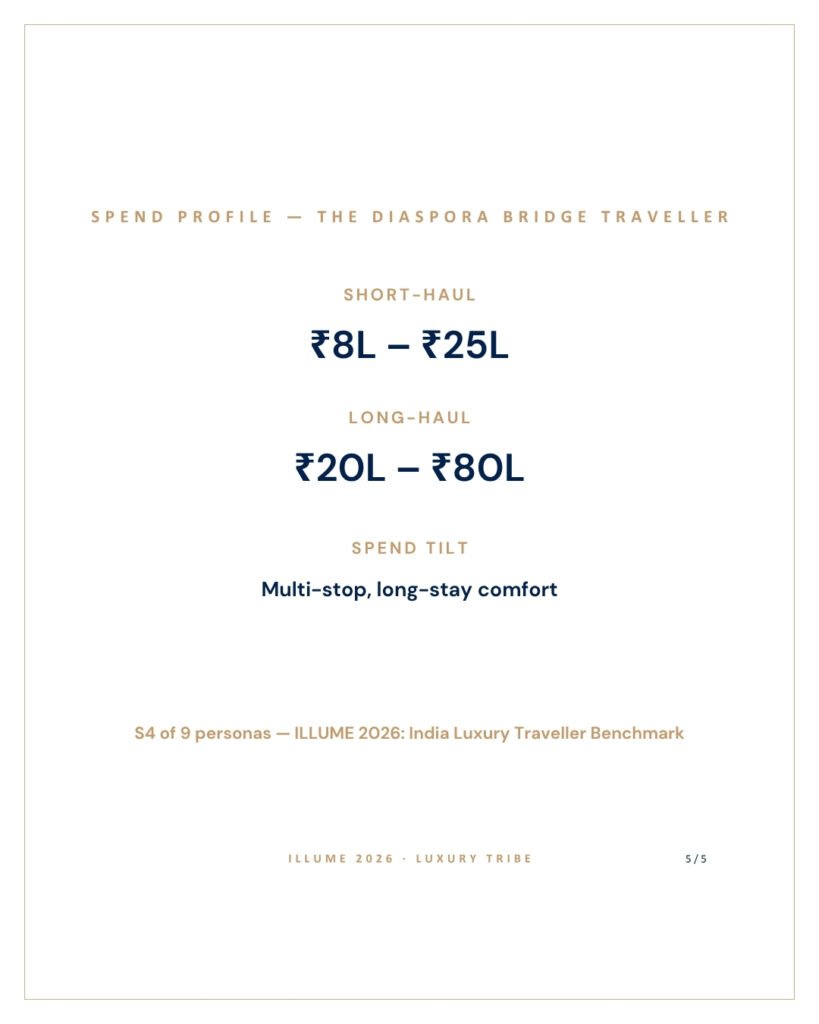
Their spend architecture reflects the structure of the journey: multi-stop, long-stay, with accommodation anchoring the family across the base. For a short-haul trip the booking party might spend between ₹8 and ₹25 lakh; for a long-haul or longer-stay journey, between ₹20 and ₹80 lakh. They value clarity, seamless cross-border logistics, and an advisor who can hold the complexity of a multi-country itinerary together.
This is where both halves of the industry misread them. Indian travel designers tend to assume the diaspora traveller wants a taste of home, heritage immersion, traditional depth, when the leisure extension actually wants the opposite: ease, energy, no further cultural labour. Global brands tend to assume the diaspora traveller behaves like a domestic Western tourist, when in fact their entire calendar is dictated by family, festival, and the obligations of belonging. The Diaspora Bridge Traveller is served well only by those who understand both the weight of the obligation leg and the release the reward leg requires.
The Diaspora Bridge
Where they sit in the nine
The Diaspora Bridge Traveller is one of nine personas, and the persona whose internal sequence most clearly contains another: the high-frequency overlap with the City-Plus Escapist is not really an overlap at all but a built-in second act, the reward leg that almost every Diaspora Bridge trip eventually becomes. They also anchor one of the framework’s most commercially significant migration pathways, the diaspora return, in which the traveller who spent decades treating India as obligation begins, in their forties and fifties, to rediscover it as a cultural destination. Heritage hotels, textile trails, temple architecture, culinary journeys through ancestral regions. These overlaps and pathways are mapped in full across the report.
That migration is the persona’s most important trajectory. By 2028, the Diaspora Bridge Traveller is moving from enduring obligation to investing in heritage, from the dutiful annual visit toward an active, high-value engagement with India as a place of cultural meaning and even of investment. The traveller who once treated the homeland as a duty begins to treat it as a destination, bringing the discernment of a global eye and the emotional attachment of a native to high-value domestic luxury travel. It is the consumption-to-contribution arc of the India Luxury Traveller Benchmark 2026 expressed across borders: the movement from passive obligation toward active, chosen belonging.
That is the larger argument, and the reason ILLUME exists as a forum to make it: the Indian luxury traveller is not one profile, and the Indian travelling abroad is not a separate species from the one travelling home. The Diaspora Bridge Traveller is the persona that holds those worlds together, and the one that reveals, more clearly than any other, that the future of Indian luxury travel runs in both directions at once.
The India Luxury Traveller Benchmark 2026 profiles all nine personas across thirteen behavioural dimensions, with origin stories, real-world signal cards, overlap and migration maps, global benchmarking, and 2026–2028 trend trajectories. A Luxury Tribe / ILLUME report.