

The Restoration Seeker
One of nine personas from the India Luxury Traveller Benchmark 2026
A Luxury Tribe / ILLUME report
The affluent Indian traveller is usually described in the language of appetite, the growing market, the rising spend, the hunger for experiences, the velocity of a class entering global luxury faster than any comparable cohort on earth. USD 72.9 billion in market value. An ultra-high-net-worth population growing fifty percent faster than the global average. The numbers describe a market reaching forward.
But some of India’s wealthiest travellers are not reaching forward at all. They are trying to stop. And the industry, conditioned to read Indian luxury as a story of more, consistently misunderstands the persona that wants less.
The India Luxury Traveller Benchmark 2026, published by Luxury Tribe and first presented at the ILLUME summit in Jaipur in March, identifies nine distinct personas within India’s affluent travelling class. Most are defined by what they want to add to their lives. This one is defined by what they need to subtract. The Restoration Seeker is the third of the five core personas, and the one whose value the global industry is slowest to recognise, because the behaviour that defines them looks, from the outside, like reluctance.
Who they are
The Restoration Seeker travels for nervous-system recovery. Not relaxation in the casual sense, not a pleasant break, but genuine repair, the systematic restoration of a body and mind that have been run past their limits. For this traveller, luxury is not stimulation. It is the absence of it. Quiet. Sleep. Space. The removal of demand.
Their defining characteristic is an aversion to chaos and a deep preference for what the Benchmark calls quiet luxury, the kind that asks nothing of them. They do not want to be entertained, dazzled, or kept busy. They want a nervous system that has been depleted to be allowed, finally, to recover. And the people who most need this are precisely the people least able to organise it for themselves, which is the central paradox of the persona.
What sets them apart from the eight personas around them is the direction of their desire. Where the Milestone Producer adds spectacle and the City-Plus Escapist adds stimulation, the Restoration Seeker is subtracting both. They are not seeking awe, like the Wild-Luxe Connoisseur, or discernment, like the Taste Investor. They are seeking the return of a baseline they have lost. The emotional aftertaste they are paying for is a single word: restored.
View this post on Instagram
Why they exist
The Restoration Seeker is the direct product of the conditions that created India’s new wealth, and specifically of the cost at which that wealth was built.
India’s economic transformation minted a generation of founders, promoters, and senior executives who built their fortunes inside an environment of relentless intensity. The pace of Indian business, the density of Indian urban life, the always-on culture of the family enterprise and the high-growth company, these produced enormous wealth and, alongside it, a specific kind of exhaustion. The Restoration Seeker is overrepresented among exactly this group: the founder, the promoter, the executive whose default condition is depletion, and whose wealth has outrun their capacity to enjoy it. The Benchmark’s research, drawn from Luxury Tribe’s survey of 700 affluent Indian travellers, identifies this concentration clearly. The persona is not evenly distributed across the affluent class. It clusters among those who paid for their success with their nervous systems.
There is a generational acceleration at work. India’s startup founders are now reaching wealth earlier, and burning out earlier, than any previous cohort, often by their mid-thirties. Restoration is no longer a concern of late middle age. It is arriving in the prime earning years, creating a Restoration Seeker who is young, wealthy, and genuinely unwell in the specific modern way of chronic stress and accumulated fatigue.
And there is a cultural shift reframing what this travel means. In an earlier era, an affluent Indian taking time to do nothing might have struggled to justify it, to the family and to themselves. The internalised audience that the Benchmark identifies across all Indian luxury travel, the family expectation, the productive self-image, does not easily permit pure rest. What has changed is the language. Wellness, longevity, biomarkers, recovery: these have given the Restoration Seeker a vocabulary in which doing nothing becomes an investment rather than an indulgence. The recovery trip is now justified to the self as “investment in health,” and that reframing is what made the persona socially possible. India’s own wellness tourism sector, valued at roughly twenty billion dollars and growing faster than the broader luxury travel market, both reflects and feeds this shift.
The Restoration Seeker
How they travel
The Restoration Seeker’s status style is the quietest in the framework. They are not signalling wealth through visibility, and in many cases are actively avoiding it. The luxury is in the calibre of the silence, the quality of the sleep, the privacy of the space, the precision of the wellness protocol, the complete absence of friction. They want longevity and recovery delivered without spectacle, and they hate chaos in any form: crowds, noise, decisions, demands.
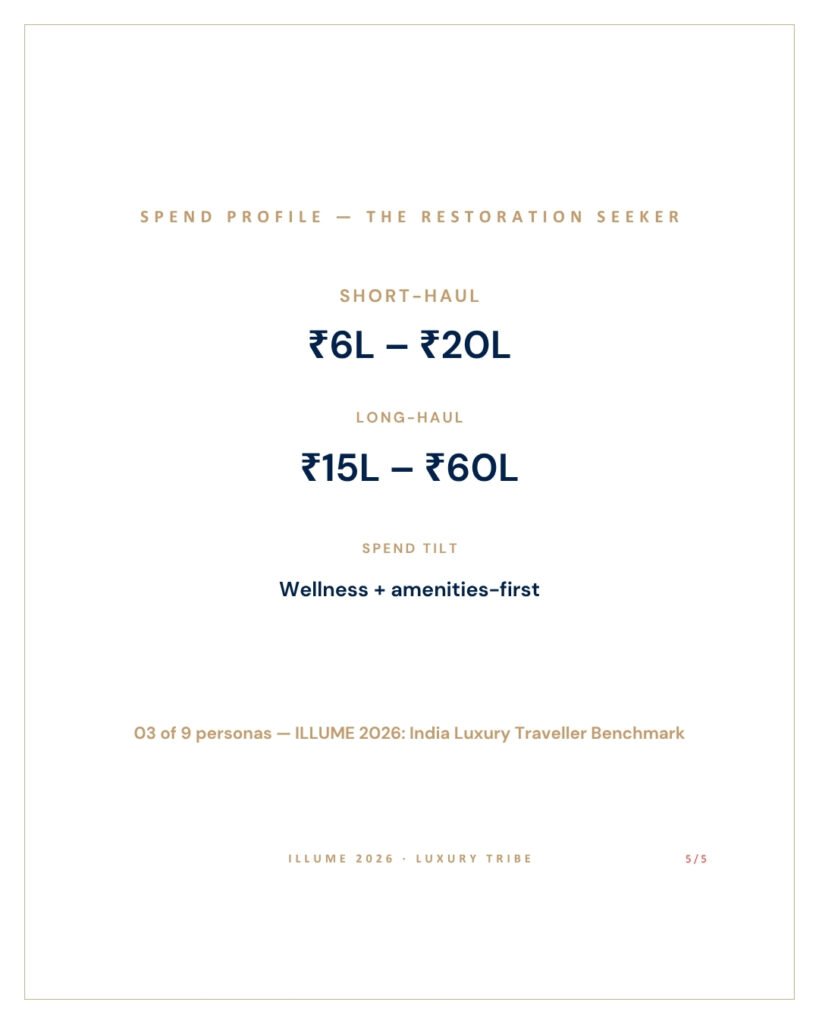
Their spend architecture is wellness-first and amenities-led. The spa is not an add-on; it is the reason for the trip. The defining markers of their spend are the wellness programme, the quality of the rooms and the rest they enable, the pools and the quiet. For a short-haul restoration trip the booking party might spend between ₹6 and ₹20 lakh; for a longer programme, between ₹15 and ₹60 lakh. These are lower figures than the production-led or family-led personas, because the Restoration Seeker is not buying scale. They are buying depth of recovery.
The thing that loses them is effort. Anything that demands cognitive load, too many choices, a complicated itinerary, a programme that requires them to engage and decide, works directly against the purpose of the trip. The Restoration Seeker arrives depleted, and a depleted person cannot project-manage their own recovery. The behaviour the industry reads as indecision, the cancelled trips, the shortened stays, the vague briefs, is not indecision at all. It is the visible symptom of a nervous system that has nothing left to give to planning.
When the trip works, the aftertaste is unmistakable and the loyalty it produces is deep. They leave genuinely restored, not entertained, not impressed, but repaired. And a traveller who has been repaired returns, reliably, to the place that repaired them.
The Restoration Seeker
Where they sit in the nine
The Restoration Seeker is one of nine personas, and their connections reveal the persona’s true commercial scale. The single highest-value overlap in the entire framework pairs the Restoration Seeker with the Sovereignty Seeker: the ultra-high-net-worth individual who is both publicly visible and privately depleted, who needs invisibility and repair at once, and whose private-villa-plus-wellness booking can exceed a crore for a ten-night stay and repeat every year. The Restoration Seeker also sits at the end of common migration pathways, the founder who burns out in their thirties, recovers, and later migrates toward the Wild-Luxe Connoisseur as energy returns and the appetite for the world comes back. These overlaps and pathways are mapped across the full report.
The trajectory sharpens the persona further. By 2028, the Restoration Seeker is moving from seeking relaxation to demanding measurable repair, from the soft language of wellness toward the hard data of longevity: biomarkers, sleep architecture, diagnostic protocols, quantified recovery. They will increasingly want proof that the repair happened, not merely the feeling of it. It is the same underlying movement the India Luxury Traveller Benchmark 2026 traces across all nine personas, from passive receiving toward active shaping, expressed here as the shift from rest as escape to recovery as engineered outcome.
That is the larger argument, and the reason ILLUME exists as a forum for it: the Indian luxury traveller is not one appetite to be fed. They are nine distinct stories, and the Restoration Seeker is the one who reminds the industry that for some of its most valuable clients, the most luxurious thing it can offer is nothing at all, delivered perfectly.
The India Luxury Traveller Benchmark 2026 profiles all nine personas across thirteen behavioural dimensions, with origin stories, real-world signal cards, overlap and migration maps, global benchmarking, and 2026–2028 trend trajectories. A Luxury Tribe / ILLUME report.