

The Multi-Gen Principal
One of nine personas from the India Luxury Traveller Benchmark 2026
A Luxury Tribe / ILLUME report
Every luxury property in the world markets itself as family-friendly. Connecting rooms, a kids’ club, a babysitting service, a children’s menu. The global industry has decided that this is what serving families means, and for most source markets it is broadly sufficient. For the affluent Indian family, it is not even close, and the gap between what the industry offers and what this traveller actually requires is where some of the largest bookings in the entire market are won or lost.
These are not small bookings. India’s ultra-high-net-worth population, growing fifty percent faster than the global average, increasingly travels not as individuals or couples but as multi-generational units, and the value of those units is substantial. The India Luxury Traveller Benchmark 2026, published by Luxury Tribe and first presented at the ILLUME summit in Jaipur this March, identifies the organiser of these journeys as one of the four specialist personas, lower in frequency than the core five, but carrying disproportionate commercial weight. This is the persona that can book a floor where another books a suite.
The Multi-Gen Principal.
Who they are
The Multi-Gen Principal is the chief executive of the family trip. They carry, in a single role, both control and care, the authority to make the decisions and the responsibility to keep three generations comfortable, content, and intact across the length of a complex journey. They are running an operation, and everyone else on the trip is, in a sense, their stakeholder.
Their signature tension is the simultaneous management of command and consideration. They must hold the whole structure together, the logistics, the budget, the schedule, while attending to the needs of people whose requirements directly contradict one another. The elders need accessibility, early dinners, short transfers, familiar food. The teenagers need stimulation, independence, late nights, a reason not to be bored. The children need to be occupied and safe. The Multi-Gen Principal must satisfy all of them at once, and the trip succeeds only if every generation feels served.
What distinguishes them from the eight personas around them is that the Multi-Gen Principal is not optimising for their own experience. They are optimising for the group’s. Their own preferences are frequently the last to be considered, because their satisfaction is defined by the satisfaction of everyone they brought. They are the persona whose luxury is the smooth functioning of a system they are personally responsible for.
View this post on Instagram
Why they exist
The Multi-Gen Principal is the product of the Indian family structure itself, meeting the new economic capacity to express it at scale.
Begin with the structure. India’s multi-child, multi-generational family is fundamentally different from the small nuclear units that dominate most other affluent source markets. The Benchmark draws the contrast sharply against China, where the one-child policy produced a generation of travellers with small families and individual decision-making authority: a Chinese couple books a suite; an Indian family books a floor. The Indian travel party is larger, structurally more complex, and more emotionally weighted, because it carries the obligations and hierarchies of the extended family with it wherever it goes. Multi-generational travel is not a trend in the Indian context. It is the expression of a family structure that has always existed, now equipped with the means to travel luxuriously.
That means is the economic force. The generation that built India’s new wealth is now at the stage of life where the family assembles, parents ageing, children growing, the milestones that gather everyone together arriving in sequence. The fiftieth anniversary, the family reunion abroad, the grandparents’ once-in-a-lifetime trip. Often a family office sits behind these bookings, managing the considerable budgets they command. The Multi-Gen Principal is the person who converts the family’s capacity into the family’s journey, and who absorbs the full complexity of doing so.
There is a cultural weight specific to India that the Benchmark documents throughout. The internalised family audience, the dynamics of parental approval that persist even for principals well into their own affluence, the dietary complexity that varies by generation and region and religious observance, the cultural expectation that the elders be honoured and the children be rooted. The Multi-Gen Principal carries all of this. Their role is not merely logistical. It is the management of a cultural institution in motion, and it is why, drawing on Luxury Tribe’s survey of 700 affluent Indian travellers and the proprietary ecosystem data of World Travel Magazine, the Benchmark treats this persona as one whose requirements no generic family offering can satisfy.
The Multi-Gen Principal
How they travel
The Multi-Gen Principal’s relationship to status runs through the success of the gathering rather than through personal display. The signal is a trip that worked, where the elders were comfortable, the children were happy, the logistics were invisible, and the family returned home with the bonds strengthened. The Multi-Gen Principal is judged, by the family and by themselves, on the smoothness of the whole.
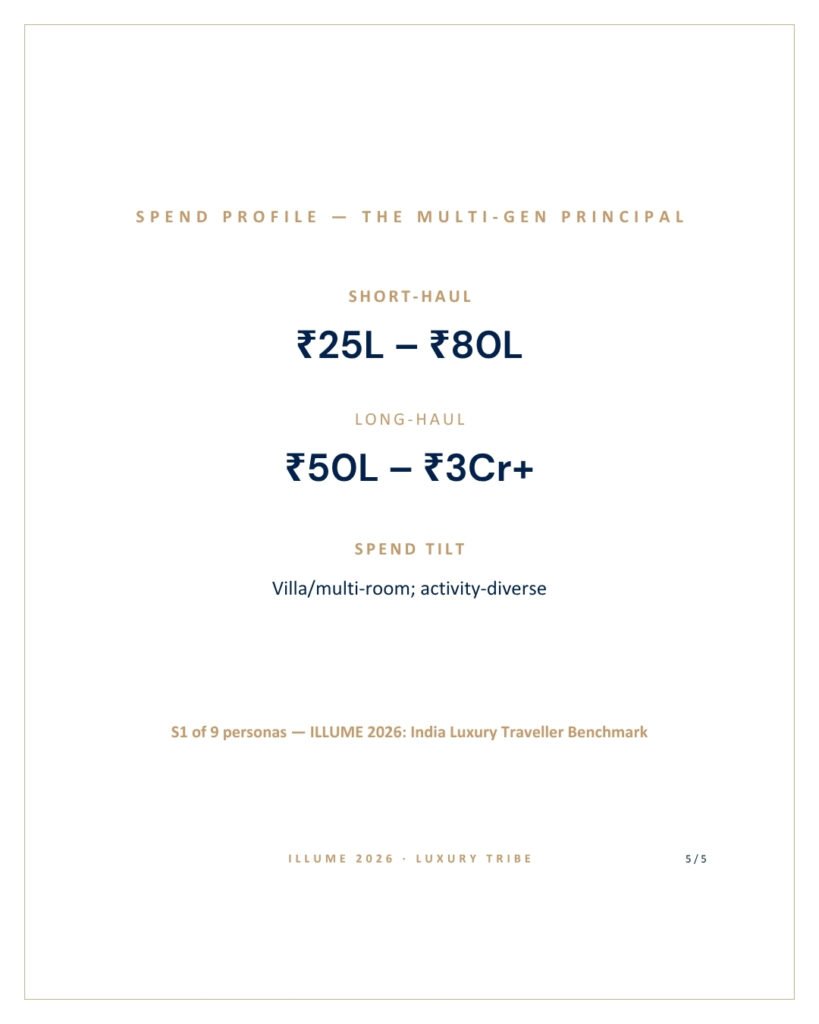
Their spend architecture is space-first. The defining requirement is room, villas, connecting suites, the physical configuration that allows a multi-generational family to be together and apart as needed, with the family-friendly infrastructure layered around it. This is the highest-spending persona in the framework at the family level: for a short-haul family trip the booking party might spend between ₹25 lakh and a crore; for a long-haul family journey, between ₹60 lakh and five crore and beyond. The scale reflects the size and complexity of what is being moved.
What loses them is any failure that disrupts the group, and this is the persona’s defining commercial sensitivity. A single logistical breakdown that embarrasses the principal in front of the family, that disrupts the elders, that breaks the careful equilibrium of the trip, can end the relationship outright. The Multi-Gen Principal has staked their authority on the trip working. A property that undermines that authority, even once, is not forgiven, because the failure is not experienced as a service lapse. It is experienced as a loss of face in front of the people who matter most.
When the trip works, the aftertaste is the quiet satisfaction of a system that held, a family served, a responsibility discharged, a gathering that will be remembered as a success. That is the Multi-Gen Principal’s reward, and it is enough to make them intensely loyal to the property that delivered it.
The Multi-Gen Principal
Where they sit in the nine
The Multi-Gen Principal is one of nine personas, and among the most overlap-prone. They pair with the Milestone Producer in the produced family milestone, the parents’ fiftieth, the wedding anniversary abroad, where the trip must be both a cinematic moment and a comfortable multi-generational assembly, two layers that cannot compromise each other. They pair with the Sovereignty Seeker when the family patriarch or matriarch is a public figure, and the entire family trip inherits UHNI-level privacy requirements. They sit at the centre of the family-arc migration pathway, the persona that emerges as couples become extended families and recedes as families become couples again. These overlaps and pathways are mapped in full across the report.
The trajectory is distinct and instructive. By 2028, the Multi-Gen Principal is moving from one-size-fits-all toward structured independence, from the single shared programme that bends everyone to one itinerary, toward parallel experiences that let each generation travel as itself within the unity of the family trip. The teenagers get their independence, the elders get their pace, the children get their world, and the family still gathers at the centre. It is the consumption-to-contribution arc of the India Luxury Traveller Benchmark 2026 expressed structurally: the move from receiving a fixed family product toward shaping a flexible family experience.
That is the larger argument, and the reason ILLUME exists to make it: the Indian luxury traveller is not one profile, and the Indian family is not a larger version of a Western one. The Multi-Gen Principal is the persona that proves it, the traveller for whom luxury is not a room or an experience, but the seamless functioning of an entire family in motion, held together by one person who is quietly running the whole thing.
The India Luxury Traveller Benchmark 2026 profiles all nine personas across thirteen behavioural dimensions, with origin stories, real-world signal cards, overlap and migration maps, global benchmarking, and 2026–2028 trend trajectories. A Luxury Tribe / ILLUME report.