

The City-Plus Escapist
One of nine personas from the India Luxury Traveller Benchmark 2026
A Luxury Tribe / ILLUME report
Of all the affluent Indian travellers a global hotel is likely to encounter, one appears more often than any other, and is misunderstood more completely than any other. They are not the highest spender in the market. They are not the rarest or the most exclusive. But they are the most frequent, the most volume-significant, and the most reliably mishandled by an international hospitality industry that keeps trying to sort them into a category they refuse to fit.
This matters because the Indian market is now too large to get wrong at volume. India holds 378,810 millionaires and a far larger upper-affluent class beneath them; it generated 38.9 million outbound departures in 2024 and USD 17 billion in international travel spend. The persona that drives the largest share of that frequent, high-value, short-haul movement is the one profiled here, and the India Luxury Traveller Benchmark 2026 names the industry’s failure to understand them as one of the most expensive blind spots in luxury hospitality.
The City-Plus Escapist. The fifth of the five core personas, and India’s most common luxury traveller.
Who they are
The City-Plus Escapist is time-efficient and rhythm-driven. They want high stimulation followed by deep calm, the best of the city and then the quiet of the resort, and they want both inside a single trip. Energy, then decompression. Density, then space. Shopping and dining and nightlife, then the pool and the silence.
Their signature tension is the appetite for intensity and the simultaneous need to recover from it. They are not choosing between the city and the escape. They want the city and the escape, in sequence, because each makes sense only in relation to the other. The stimulation is incomplete without the calm that follows; the calm is unearned without the stimulation that preceded it.
This is precisely where the global industry misreads them. International hospitality assumes that a city break and a resort holiday are two different products for two different customers. For the City-Plus Escapist, they are two phases of one trip for one customer. The same person who wants the best restaurant table in Dubai on Tuesday wants a quiet beach villa in Ras Al Khaimah on Thursday. The Benchmark is emphatic on this point: this is not indecision. It is rhythm management, and the property that forces the traveller to be either a “city guest” or a “resort guest” has misunderstood the entire architecture of their trip.
View this post on Instagram
Why they exist
The City-Plus Escapist was born from a specific condition of contemporary Indian life, and three specific forces that shaped it.
The condition is urban intensity. India’s upper-affluent class, urban professionals, dual-income couples, founders of mid-stage companies, senior executives in multinationals, lives at a velocity few global peer groups match. The Benchmark describes it precisely: Mumbai’s commute, Bengaluru’s traffic, Delhi’s social calendar. The density and pace of Indian metropolitan life produce a particular psychic state, permanent stimulation coupled with permanent fatigue. The City-Plus Escapist is the traveller this condition creates. They do not want to escape the city entirely. They want to replicate its energy in a better setting, and then, finally, decompress. The travel pattern is a direct mirror of the life.
Three India-specific forces, documented in the report, turned that condition into a persona. The first is the short-haul luxury corridor, Dubai, Singapore, Thailand, Sri Lanka, the Maldives, made accessible by a proliferation of direct flights, business-class deals, and the normalisation of the long weekend abroad among India’s upper-affluent. The geography of Indian luxury travel was rewritten by proximity and frequency. The second is India’s domestic luxury retail gap: when certain brands, products, or selections simply are not available at home, travel becomes a retail extension, and shopping becomes a structural driver of the trip rather than an incidental pleasure. The third is social architecture. In a peer group where everyone is affluent, the question is no longer whether you travelled but where you ate, what you bought, and whether it was worth it. Travel becomes activity-dense by social necessity, the trip must be full enough to be retold.
The Benchmark’s research, drawn from Luxury Tribe’s survey of 700 affluent Indian travellers and the proprietary ecosystem data of World Travel Magazine, identifies the City-Plus Escapist as the most volume-significant persona in the entire framework, and notes, with some emphasis, that this volume significance is exactly why misreading them is so costly. They are not an edge case. They are the centre of gravity.
The City-Plus Escapist
How they travel
The City-Plus Escapist’s status style runs through activity and access rather than quiet exclusivity. The signal is the restaurant that is hard to get into, the shopping that is not available at home, the trip that was full and varied and worth talking about. It is a sociable, visible form of luxury, calibrated to a peer group that is paying attention.
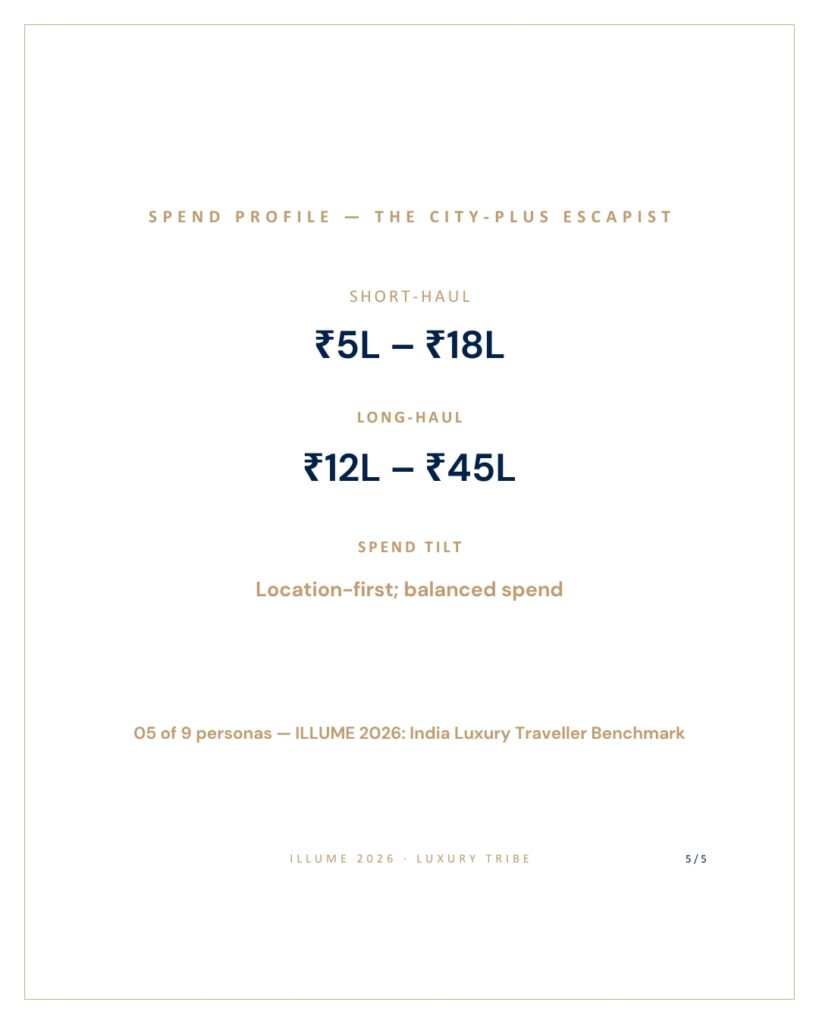
Their spend architecture is location-first and amenities-first. The position of the property matters enormously, central to the action in the city phase, genuinely restful in the escape phase, as do the amenities that define each phase. And then there is shopping, which the Benchmark flags as the persona’s wild card: shopping variance can spike unpredictably, turning a moderate trip into a major one on the strength of a single retail decision. For a short-haul trip the booking party might spend between ₹5 and ₹18 lakh; for a long-haul trip, between ₹12 and ₹45 lakh, with the upper bounds frequently driven by exactly that retail spike.
What loses them is friction and rigidity, an experience that forces them into a single mode, that cannot accommodate both the high-energy phase and the recovery phase, that treats the trip’s two halves as a contradiction to be resolved rather than a rhythm to be served. The City-Plus Escapist does not want to be told what kind of traveller they are. They want a trip that moves the way they move.
When it works, the trip delivers exactly the rhythm they came for: the intensity fully met, the recovery fully delivered, the whole sequence dense enough to satisfy and varied enough to retell.
The City-Plus Escapist
Where they sit in the nine
The City-Plus Escapist is one of nine personas, and among the most connected to the others. They overlap with the Milestone Producer in the compressed city celebration, the birthday weekend in Dubai or London built around a single peak moment with shopping and nightlife around it. They are, crucially, the form that the Diaspora Bridge Traveller’s reward leg almost always takes: after two weeks of family obligation in India, the leisure extension becomes a short, high-energy City-Plus break before the resort reset. And they sit at the beginning of one of the most important migration pathways in the framework, the City-Plus Escapist of the thirties who becomes the Taste Investor of the mid-forties, as the appetite for stimulation matures into the appetite for meaning. These overlaps and pathways are mapped across the full report.
The trajectory is distinct. By 2028, the City-Plus Escapist is moving from planned itineraries toward self-directed discovery, from the structured, advisor-built trip toward a more spontaneous, independently navigated one, enabled by the same digital fluency and confidence that defines India’s younger affluent class. It is the consumption-to-contribution arc of the India Luxury Traveller Benchmark 2026 expressed in its most personal form: the traveller taking authorship of the trip itself.
That is the larger argument, and the reason ILLUME exists to make it: the Indian luxury traveller is not one profile, and the most common of them is not the simplest. The City-Plus Escapist is the persona the global industry sees most often and understands least, and getting them right, at the volume they represent, is among the largest opportunities the Indian market offers.
The India Luxury Traveller Benchmark 2026 profiles all nine personas across thirteen behavioural dimensions, with origin stories, real-world signal cards, overlap and migration maps, global benchmarking, and 2026–2028 trend trajectories. A Luxury Tribe / ILLUME report.