

The Taste Investor
One of nine personas from the India Luxury Traveller Benchmark 2026
A Luxury Tribe / ILLUME report
For most of the last decade, the global luxury industry has watched India’s affluent class with a single question in mind: how much will they spend? It is the wrong question, or at least an incomplete one. India now holds 378,810 millionaires, adds more than thirty thousand a year, and anchors a luxury travel market worth USD 72.9 billion. The spending is established. What the industry has failed to map is the far more consequential matter of judgement, how this traveller decides what is worth spending on, and what they quietly hold in contempt.
No persona makes that failure more costly than the one profiled here. Because the Taste Investor is the affluent Indian traveller who has stopped being impressed by price, and started being impressed by discernment, and a property that pitches them on expense, ranking, or popularity has already lost them before the conversation begins.
The India Luxury Traveller Benchmark 2026 identifies nine distinct personas within India’s affluent travelling class, replacing the single-profile shorthand that has governed the industry’s thinking for too long. The Taste Investor is the second of the five core personas, and in many ways the one that signals where the entire market is heading.
Who they are
The Taste Investor travels to accumulate discernment. Where another traveller collects destinations, photographs, or stamps in a passport, this one collects understanding, the chef’s philosophy, the vineyard’s terroir, the provenance of the object, the lineage of the craft. Every trip is a deposit into a slowly compounding account of cultural fluency.
Their signature tension is the desire for the exceptional that is, at the same time, not obvious. They want what is genuinely excellent, but they need it to be theirs, discovered, considered, slightly hidden, rather than something anyone with a budget could have booked. The moment an experience becomes widely celebrated, it loses value for them. This is the persona that recoils from the phrase “our most popular” and reaches instead for “not on the public menu.”
What distinguishes them from the eight personas around them is the emotional register of the reward. The Milestone Producer wants to feel admired. The Restoration Seeker wants to feel restored. The Taste Investor wants to feel sharper, enriched, more knowledgeable, more refined than when they arrived. They reject anything mass, hyped, or generic, and that rejection includes the very signals the industry is most proud of: the awards, the rankings, the celebrity endorsements. To the Taste Investor, a Condé Nast number is not a recommendation. It is a warning that the place has already been found.
View this post on Instagram
Why they exist
The Taste Investor is the product of a specific moment in the maturation of Indian wealth, the point at which product luxury saturates and cultural luxury takes its place.
For the first wave of liberalised Indian wealth, luxury was a noun. A bag, a watch, a car, a suite. These things signalled arrival, and arrival was the goal. But India’s luxury goods market has now crossed ten billion dollars and continues to grow, which means that owning the objects of luxury no longer distinguishes anyone. When everyone in the room can buy the product, the product stops working as a status signal, and status migrates to something that cannot simply be purchased: knowledge, taste, the capacity to tell the considered from the conspicuous. This is the economic engine beneath the persona. Discernment becomes the new scarcity.
There is a generational force layered on top of this. One in five Indian millionaires is now under forty, and this younger affluent cohort has come to wealth already globally exposed, educated abroad, fluent in international cultural codes, comfortable in the world’s restaurants and galleries from the start. They did not need travel to prove they had money. They use travel to prove they have taste, which is the harder and more interesting thing to prove. The Benchmark’s research, drawn from Luxury Tribe’s survey of 700 affluent Indian travellers and the proprietary ecosystem data of World Travel Magazine, identifies this shift from display toward discernment as one of the fastest-moving currents in the entire market.
And there is a cultural assertion at work that is distinctly Indian. The Taste Investor is part of the generation building India’s cultural confidence in real time. When this traveller orders a vegetarian tasting menu at a Michelin restaurant in Copenhagen, they are not apologising for a constraint. They are asserting that Indian dietary tradition belongs inside global fine dining on equal terms. The same instinct sends them toward Indian textiles in global fashion, Ayurveda alongside Western longevity science, regional craft traditions reframed as objects of serious cultural interest. India enters global luxury, in this persona, not as a consumer absorbing Western codes but as a contributor insisting its own codes have standing. The Taste Investor is the traveller in whom that insistence is most fully formed.
The Taste Investor
How they travel
The Taste Investor’s status style is what the Benchmark calls taste-flex: they signal not through visible expense but through the quality of what they have chosen, and the knowledge that informed the choosing. The flex is the obscure vineyard, the chef trained under a name only insiders recognise, the design hotel that has never advertised. It is a quieter signal than the Milestone Producer’s, and a more demanding one, because it requires the audience to understand what they are looking at.
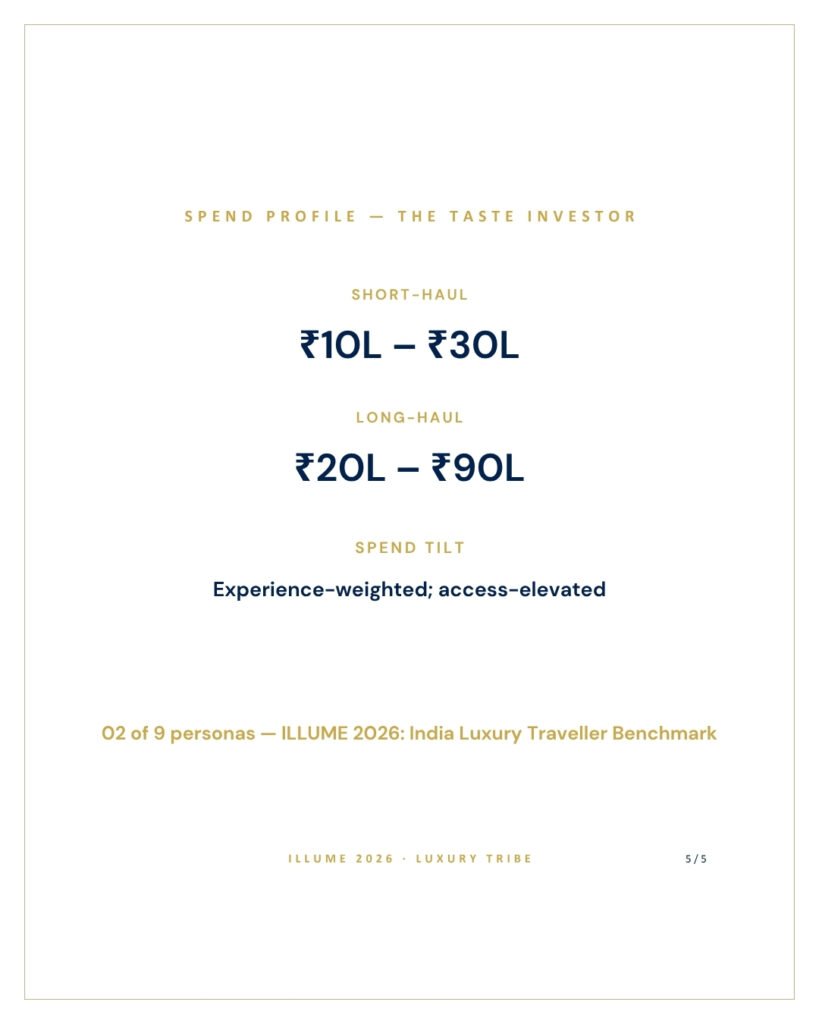
Their spend architecture is experience-weighted. The accommodation is chosen with intention rather than treated as the hero of the trip, a well-considered property matters, but it is the access and the context that command the budget. Curators, ateliers, chef’s tables, private cultural moments: this is where the Taste Investor spends, and where they spend without hesitation. For a short-haul cultural trip the booking party might spend between ₹10 and ₹30 lakh; for a long-haul immersion, between ₹20 and ₹90 lakh. The figures are lower than the Milestone Producer’s because the Taste Investor is not paying for production. They are paying for substance.
What ends the relationship is the generic. The hyped restaurant, the obvious recommendation, the experience that has been packaged for everyone. The Taste Investor reads these as evidence that the advisor does not understand them, and once that judgement is made, it is rarely reversed. They are not difficult for the sake of difficulty. They simply hold a standard, and the standard is that the experience must reward intelligence as well as money.
When it does, the aftertaste is the one they came for. They leave sharper than they arrived. The trip has added something to them, a new reference point, a deepened understanding, a story that signals taste rather than spend when it is retold. For the Taste Investor, that accumulation is the entire purpose of travel.
The Taste Investor
Where they sit in the nine
The Taste Investor is one of nine personas, and one of the most connected. They frequently travel as the quiet quality filter inside a Milestone Producer’s booking, the spouse who insists the celebration carry provenance, not just spectacle. They overlap with the Access Collector, though the motivations differ: the Taste Investor wants depth, the Access Collector wants scarcity, and the trips where both instincts live in one traveller become curated circuits of insider cultural moments. And the Taste Investor is, more than any other, the destination of a lifetime’s migration. The City-Plus Escapist of the thirties becomes the Taste Investor of the mid-forties, as the appetite for stimulation gives way to the appetite for meaning. These overlaps and migration pathways are mapped in full across the report.
The trajectory points further in the same direction. By 2028, the Taste Investor is moving from accumulating taste to enabling it, from consuming culture toward participating in it, commissioning it, sustaining it. It is the same arc the India Luxury Traveller Benchmark 2026 traces across all nine personas: the movement from consumption to contribution, from receiving the experience to shaping it. The Taste Investor was simply there first. They are the persona that told the industry, before any of the others, that the Indian luxury traveller had stopped asking what a place could give them, and started asking what they could understand about it.
That is the shift ILLUME exists to document, and the reason this framework matters: the brands that grasp the Taste Investor’s logic are not just winning a client. They are reading the future of the market.
The India Luxury Traveller Benchmark 2026 profiles all nine personas across thirteen behavioural dimensions, with origin stories, real-world signal cards, overlap and migration maps, global benchmarking, and 2026–2028 trend trajectories. A Luxury Tribe / ILLUME report.